1. How does your organization’s mission and/or work relate to conserving salmon habitat in the Mat-Su (or statewide)?
ADF&G’s mission is to protect, maintain, and improve the fish, game, and aquatic plant resources of the state, and to manage their use and development in the best interest of the economy and the well-being of the people of Alaska. Conserving salmon habitat—both in the Mat-Su and statewide—is central to that mission, as healthy habitats are essential to sustaining salmon populations and the benefits they provide to communities and ecosystems.
2. What is your role with your organization?
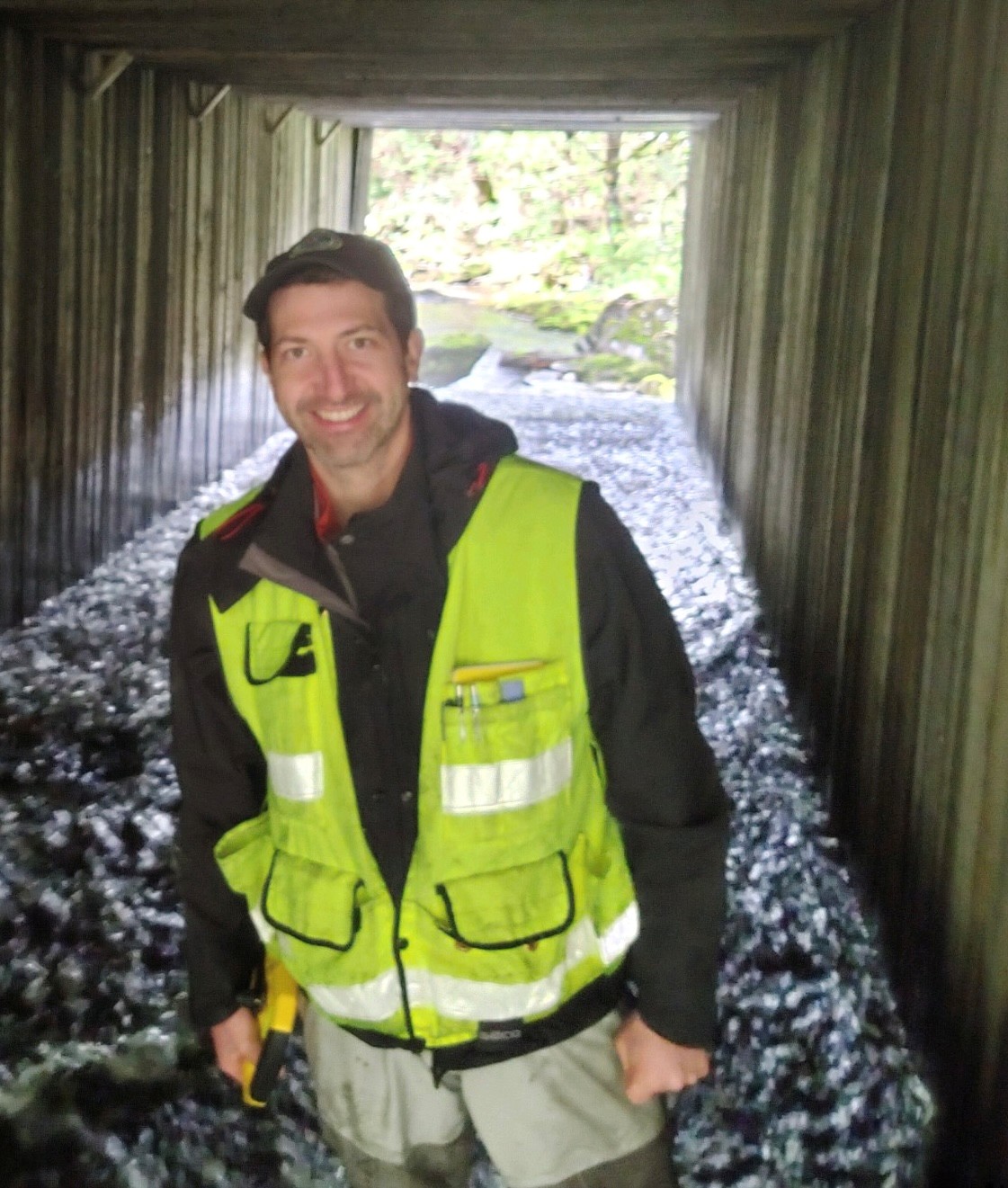
Although I am a habitat biologist by training, I work within the Division of Sport Fish as the Program Manager for the Fish Passage Improvement Program. The program assesses culverts across the state through the lens of fish passage and provides technical expertise and assistance for fish passage projects. This information is used by restoration groups planning culvert replacement projects, by road managers planning upgrades, and for watershed assessments and other decision-making tools.
3. Why is being a member of the Mat-Su Salmon Habitat Partnership (MSSHP) important to your organization?
The answer is through building strong relationships with dedicated partners. Like all major problems in the world, Alaska’s fish passage issue cannot be solved by a single individual or agency. One of the hallmarks of Alaska’s fish passage efforts is the collaborative approach involving various stakeholders. Local communities, government agencies, tribal organizations, and conservation organizations have joined forces to implement fish passage projects across the state. This collaborative approach and its success in the Mat-Su is rooted to the relationships forged through the MSSHP.
4. What is your role in salmon habitat work in the Mat-Su?
I have been involved in salmon habitat work in the Mat-Su in some capacity since 2013, when I worked on baseline data collection for the Susitna-Watana Hydroelectric Project’s environmental studies. Since then, I have worked in both the private and public sectors on a range of efforts, including instream flow studies, stream temperature monitoring, and habitat restoration projects.
Currently, with the Fish Passage Improvement Program I have worked with many Mat-Su Salmon Habitat Partnership members to identify problematic culverts, write grants to fund their replacement, and provide technical assistance through the design and construction phases. Although I am stepping down from my role as a steering committee member, it has been both a pleasure and an honor to serve on the Steering Committee since late 2019.
5. Can you share one project or effort you’re especially proud of right now?
I am very proud of the MSSHP’s community planting day, also known as plants for salmon. The concept of a community planting day, as an outreach event the Partnership hosted, was something I worked hard to get off the ground. The fourth annual planting day was held last year along Montana Creek. Although it has its own momentum now, it was an event that took a bit of energy to first get moving. What I like most about the event is that I think it offers a great visual representation for what the MSSHP is at its core. You have multiple organizations and agencies coming together, interacting with the public, while completing an on-the-ground conservation project. I have always been impressed at how so many different partners come together and support the project in whatever capacity they are able to do so. Whether it is an organization taking the lead as the host, financially helping, supplying materials, or just coming out to plant, the partnership has shown up time and time again. Plus, how could you not feel better after adding something simple but beautiful to the world?
6. Why does the work of the MSSHP matter: to you, your community, or the watershed?
The Partnership matters because it brings together a community of people who genuinely care about salmon and the habitats that support them. It has been a place where relationships are built, collaborations are fostered, ideas take root, and projects find their shape. That collective effort is the difference maker for the success of work on the ground and across the watershed.
7. What’s one project you are working on that relates to the partnership’s work?
There is a project that has been chugging along for a while, located within the Palmer Hay Flats Wildlife Refuge on a mile long unpaved remnant stretch of Nelson Road that stretches between the Glenn Highway and South Trunk Road. Today the remnant stretch of Nelson Road is utilized mostly as a recreation path, popular amongst dog walkers, joggers, and birders, and hunters who enjoy the surrounding natural beauty. Along this stretch of road, there are currently 4 culverts which convey water from Spring Creek, a tributary to Wasilla Creek, and an anadromous waterbody supporting rearing and spawning coho salmon.
These four existing culvert crossings are in dire shape and actively failing, limiting fish passage, hydrological conveyance, and ecological function in Spring Creek, as well as creating a safety concern to all foot and motorized traffic.
This project is a collaboration between ADF&G and U.S. Fish and Wildlife Service, with support from the other MSSHP partners including Mat-Su Borough, Knik Tribal Conservation District, and the Mat-Su Trails and Parks Foundation. The hope is to address both the salmon barrier problem and the human access issue in one project. If all goes to plan, all 4 failing culverts will be removed, resulting in opening up a total of 2.22 miles of upstream for salmon rearing and spawning habitat. Instead of installing new culverts our hope is to restore the natural channel and install pedestrian bridges over the top. Because the road prism has impounded enough water on the upstream side to create a wetland pond, the project design will incorporate elements to allow for fish passage but also maintain the wetland water elevation for wildlife habitat.
8. What gives you hope when you think about the future of Mat-Su salmon?
What gives me the most hope is how deeply people care about salmon in the Mat-Su. At a time when it can feel difficult to find common ground on almost anything, the importance of salmon on both an individual and community level seems to be something nearly everyone can agree about.